What does it actually take to get a Formula 1 drive? Not the talent part, the money part. According to Australian journalist Stewart Bell, somewhere between eight and sixteen million US dollars, depending on whether you have academy backing. That figure alone tells you something about the sport his new book sets out to expose.
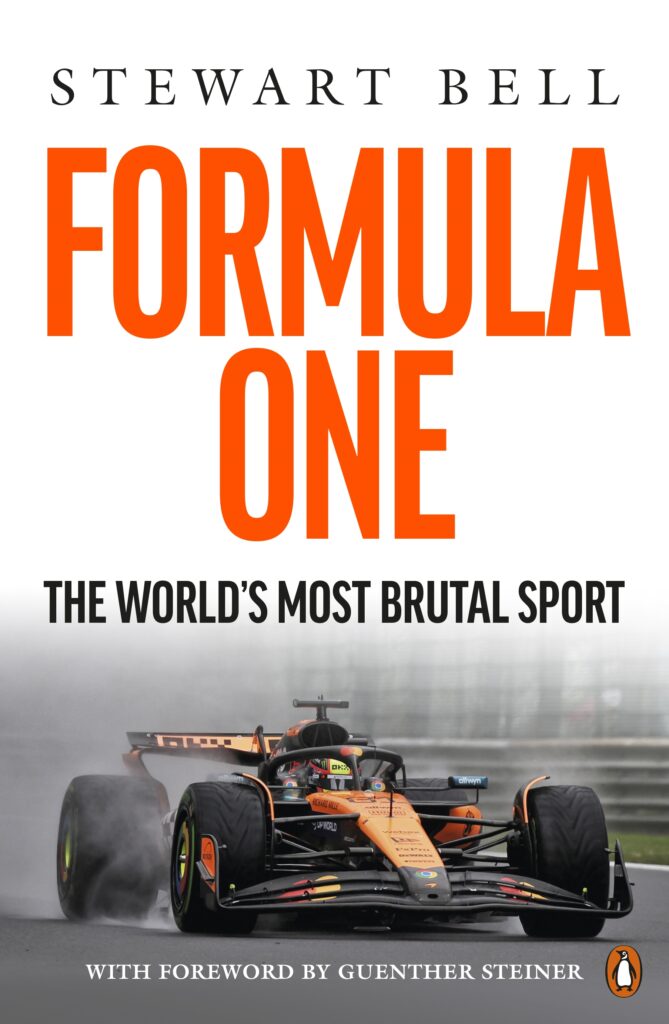
Bell has been covering Formula 1 since 2007, when he turned up at the Australian Grand Prix with no contacts, no racing background and, by his own admission, ambition well in excess of his talent. Two decades later he has edited the official Australian Grand Prix program, produced a weekly television show, managed media strategy for the Singapore Grand Prix, and accumulated enough paddock stories to fill a book. Which he did. Published by Penguin, Formula 1: The World’s Most Brutal Sport is part career retrospective, part reference guide for anyone who has watched Drive to Survive and wants to understand what is actually happening behind the garage doors.
Bell joined Dianne Bortoletto on Away We Go Podcast to talk through the book, the sport, and some of the drivers he has interviewed over the years. The conversation moves from Daniel Ricciardo, who Bell first encountered as the only media in the garage for Ricciardo’s first Albert Park run with Toro Rosso, to Kimi Raikkonen, who Bell describes as a journalist’s nightmare and a gift in equal measure. The GQ India story alone is worth the listen: Bell was commissioned for a lifestyle feature on Raikkonen, knew immediately it would never work, and ended up negotiating a pre-written sheet of Kimi lifestyle answers from the Lotus press team to fill the gaps.
The book is structured in two halves. The first tracks the driver lifecycle from karting budget to Formula 1 seat, the second goes inside the machinery of the sport: the mechanics, engineers, governance, scandals, and technical battles that rarely surface in broadcast coverage. Bell describes it as a reference book for the converted, not a nostalgia trip, and the writing process matched the subject matter for intensity. Five thousand words a week for four months, on top of a full-time production schedule and a family, writing across two laptops simultaneously.
One of the more sobering threads in the conversation is a story that ended up in the book: Bell’s interview with Betise Assumpcao Head, Ayrton Senna’s longtime press officer, about the day Senna died at Imola on 1 May 1994. The detail she shared with Bell, including Gerhard Berger arriving at the hospital and leaving white-faced, had never made it into any account Bell had read in years of studying the sport. It is the kind of access that defines what separates a working journalist from a fan with a press pass.
Bell is measured on the current season’s new regulations, acknowledging that the racing itself has been competitive while arguing that the qualifying format, where drivers are managing battery deployment rather than attacking the limit, is undermining one of the sport’s core appeals. His view on Lewis Hamilton’s chances of an eighth title is similarly clear-eyed: Ferrari’s trajectory makes it possible, but not on current form.
Formula 1: The World’s Most Brutal Sport is available now on Amazon.
LINKS
BOOK: Formula 1: The World’s Most Brutal Sport: https://amzn.to/4nAWaNj
Stewart Bell on Instagram: http://instagram.com/StewartBellF1
Stewart Bell website: http://www.stewart-bell.com
.
Related Posts
“our Japan destination deep-dive” – Stewart answers Japan as his holiday destination. Listen to our special Japanese Travel Ep66 with Tess Moone here
Di references the Annie Bradshaw’s interview when talking about Lance Stroll – Listen to Ep9 Annie Bradshaw here